
White Paper Report

2026 Q1 White Paper: Private Credit Under Pressure

March 5, 2026
Download PDFWatch Video

Private Credit Under Pressure

Speculation has swirled in recent weeks about the private credit market after several publicly traded alternative managers have come under pressure. Blue Owl, a public alternative asset manager had to restrict redemptions from one of its semi liquid credit funds as investors rushed to pull money on default fears. The angst quickly spread to other publicly traded alternative managers (e.g., KKR, Apollo Global Management and Blackstone) as seen by the S&P 500 Asset Management Index down over 15% from its recent peak. In addition, several reputable CEOs and global banks are warning about the default risk in the private credit space (e.g., Jamie Dimon and UBS).

In this publication we want to address the catalysts for the recent anxiety in the public market. We also want to discuss the differences between what is going on in the public markets and what we see in the illiquid private credit markets. Especially our approach to how we evaluate private credit managers.

Catalysts for Recent Sell-off in Public Alternative Managers

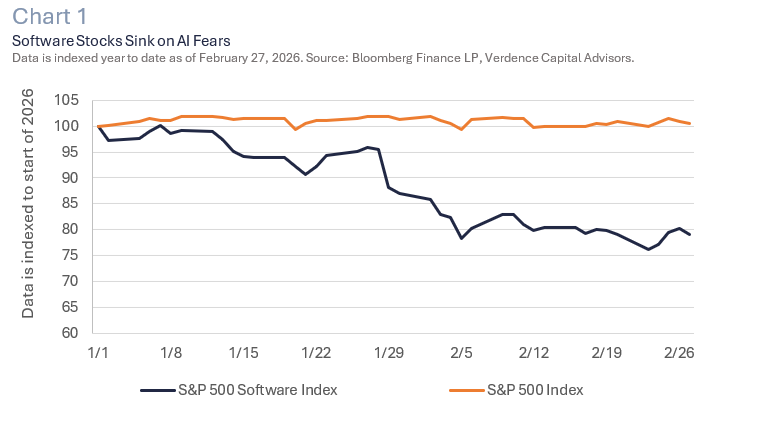
  • Default fears: The speculation that AI would reduce the demand for software has caused a broad selloff in software stocks. The S&P 500 Software Index has fallen more than 30% from its recent high (Chart 1). It is estimated that private credit (especially through business development companies) has ~20% of its loans tied up in software companies.1 With the selloff in software stocks, the fears of widespread defaults have increased and spread to other public asset managers that hold these loans.
  • Weaker lending standards: During and after the pandemic, lending standards for private credit began to loosen. This is especially true for lower rated companies. For example, we saw a surge in covenant lite structures. These structures allow lenders to reduce or eliminate certain covenants (e.g., cash flow testing, minimum EBITDA levels). We also saw an uptick in pay in kind (PIK) structures which means the borrower can skip interest payments and instead add it to the balance of the loan. This may be tolerable when rates are low, but when it is late in a credit cycle and when the Fed may be on hold instead of cutting rates, these loans can become problematic.
  • Refinancing wall: Many loans originated in the aftermath of the pandemic (2020-2021) and this year they are approaching their fifth year. Many loans will need to be refinanced or restructured. It is estimated that between $300-$350 billion of leveraged and private credit is entering a “refinancing window.”
  • Liquidity stress: The loans that private credit managers own are not easy to sell quickly. These loans tend to be illiquid and can be longer in duration. When these loans are placed in a vehicle where redemptions are allowed it can create a liquidity squeeze if too many investors want to redeem at the same time.

private credit risk, private credit due diligence


The Difference Between Public Market Turmoil and Private Market

While we outlined the reasons why investors may be growing nervous about private credit, it is important to understand the difference between what is going on with public asset managers and the truly illiquid private credit space. Those managers that trade publicly and own anything that comes under pressure can easily see their stock price in a downward spiral as investors rush to sell. Especially, if that company is in the business of making loans, fear can turn into indiscriminate selling of other companies in that sector.

That turns into investors rushing to pull money from these companies’ funds, and it creates a liquidity issue and not always because of an underlying credit issue. A lot of recent concerns have been concentrated around business development corporations, illiquid real estate investment trusts and insurance backed vehicles. All of these have the same liquidity challenges when sentiment falls (e.g., redemptions), and some have higher credit risk.

Managers in the illiquid private credit space do not have the same volatility challenges as we have mentioned above. While we acknowledge that some of the above risks may pertain to the illiquid markets (e.g., easing lending standards, AI overspend), private credit as an alternative asset class that has historically proven to be a good long-term investment when the appropriate due diligence is conducted.

How do we Evaluate Private Credit Managers?

Effective due diligence in the illiquid private market starts with deep understanding of the manager’s strategy, risk management, and verifying they have a rigorous underwriting process.  That means clarifying what part of the market they target (sponsor vs. non‑sponsor, core direct lending vs. opportunistic/recurring‑revenue risk), how they source and pass on deals, and whether fund size and deployment pace are realistic for those markets and the existing opportunity set. It is important to have in depth knowledge of how private credit managers’ price and structure risk, the amount of leverage they utilize, how tight covenants are, how they evaluate the use of complex features (e.g., pay in kind), what sectors they allocate to and how much concentration they may have.

Equally important is operational, structural and alignment due diligence, given the illiquid and opaque nature of private credit. Understanding the structural matching of liquidity is also a key part of the due diligence process. This is  highlighted above with Blue Owl’s struggles where investors no longer have the right to tender a fixed percentage of shares each quarter. Blue Owl’s situation represents a real example of liquidity risk and poor underwriting in semi‑liquid private credit, particularly in concentrated segments like software.

Blue Owl’s situation represents a real example of liquidity risk and poor underwriting in semi-liquid private credit, particularly in concentrated segments like software.

Verdence View

The current struggles in public asset managers are not, in our view, an indication that the private credit asset class is broken. Instead, it reinforces our existing belief that due diligence is extremely important. It’s important in the evaluation of not only private credit, but all alternative managers. In addition, having a knowledgeable team that can evaluate private credit managers to analyze their risk/reward potential for the long run is vital. We believe that private credit will continue to be an important part of a well-diversified alternative portfolio. While we are not adding any additional managers at this time, we continue to favor managers and vehicles with strong underwriting standards, diversified portfolios, and well identified liquidity terms that allow for robust secondary‑market access.

If you have any questions or comments, please reach out to your financial advisor.

Megan Horneman | Chief Investment Officer
Matthew Andrulot | Executive Director of Verdence/RIA+

Past performance is not indicative of future returns

Disclaimer: © Verdence Capital Advisors, LLC

Reproduction without permission is not permitted. The indexes presented are unmanaged portfolios of specified securities and do not reflect any initial or ongoing expenses nor can it be invested in directly. An investment’s portfolio may differ significantly from the securities in the index.  This material was prepared by Verdence Capital Advisors, LLC (“VCA” or “we”, “our”, “us”). VCA believes the information and data in this document were obtained from sources considered reliable and correct and cannot guarantee either their accuracy or completeness. VCA has not independently verified third-party sourced information and data. Any projections, outlooks or assumptions should not be construed to be indicative of the actual events which will occur. These projections, market outlooks or estimates are subject to change without notice. This material is being provided for informational purposes only and is not intended to provide, and should not be relied upon for, investment, accounting, legal, or tax advice. Past performance is not a guarantee of future results. Different types of investments involve varying degrees of risk, and there can be no assurance that the future performance of any specific investment, investment strategy, or product or any non-investment related content, made reference to directly or indirectly in these materials will be profitable, equal any corresponding indicated historical performance level(s), be suitable for your portfolio or individual situation, or prove successful. You should not assume that any discussion or information contained in this report serves as the receipt of, or as a substitute for, personalized investment advice from VCA. Alternative investments are designed only for sophisticated investors who are able to bear the risk of the loss of their entire investment. Investing in alternative investments should be viewed as illiquid and generally not readily marketable or transferable. Investors should be prepared to bear the financial risks of investing in an alternative investment for an indefinite period of time. Due to various factors, including changing market conditions and/or applicable laws, the content may no longer be reflective of current opinions or positions. All indexes are unmanaged, and you cannot invest directly in an index. Index returns do not include fees or expenses. Sector Watch Use of this website is intended for U.S. residents only. Any recommendation, opinion or advice regarding securities or markets contained in such material does not reflect the views of Verdence Capital, and Verdence Capital does not verify any information included in such material. Verdence Capital assumes no responsibility for any fact, recommendation, opinion, or advice contained in any such research material and expressly disclaims any responsibility for any decisions or for the suitability of any security or transaction based on it. Any decisions you may make to buy, sell, or hold a security based on this research will be entirely your own and not in any way deemed to be endorsed or influenced by or attributed to Verdence Capital. It is understood that, without exception, any order based on such research that is placed for execution is and will be treated as an UNRECOMMENDED AND UNSOLICITED ORDER. Further, Verdence Capital assumes no responsibility for the accuracy, completeness, or timeliness of any such research or for updating such research, which is subject to change without notice at any time. Verdence Capital does not provide tax, or legal advice. Under no circumstance is the information contained within this research to be used or considered as an offer to sell or a solicitation of an offer to buy any particular investment/security. Fixed income securities are subject to increased loss of principal during periods of rising interest rates. Fixed income investments are subject to various other risks including changes in credit quality, market valuations, liquidity, prepayments, early redemption, corporate events, tax ramifications and other factors. Lower rated securities are subject to greater credit risk, default risk, and liquidity risk. Commodity‐related products, including futures, carry a high level of risk and are not suitable for all investors. Commodity‐related products may be extremely volatile, illiquid and can be significantly affected by underlying commodity prices, world events, import controls, worldwide competition, government regulations, and economic conditions, regardless of the length of time shares are held. Data is provided for information purposes only and is not intended for trading purposes. Verdence Capital shall not be liable for any errors or delay in the content, or for any action taken in reliance on any content. Weekly Insights/Qtrly & Annual Outlook The indexes presented are unmanaged portfolios of specified securities and do not reflect any initial or ongoing expenses nor can it be invested in directly. An investment’s portfolio may differ significantly from the securities in the index. Semi-Annual Chart Pack Where shown, performance information presented is that which has been calculated and presented by an unaffiliated third-party manager. We have no insight into the performance of the advisor/product/account or fund shown and do not attempt to determine whether the performance presented is accurate. Therefore, the performance could be incorrect, overstated or not reflective of actual trading of client funds. There is the potential that the performance shown is a back test and not the result of real investment advice and trading. As such, it could not be relied upon as indicative of future returns of a particular strategy. Where performance shown is that of a pooled account, limited partnership, or private equity fund, you should be aware that there is a significant lack of transparency into the operations and investment process and investment vehicles invested in. As a result, pricing and valuation of the underlying holdings which produced the stated performance could be incorrect, stale, or overstated and therefore the performance figures presented cannot be relied upon. Before investing, we encourage you to request additional information, particularly performance information, of any product that you are considering for your client. You should read, as applicable, the Prospectus, SAI, Composite Disclosure and/or performance disclosure associated with any product that you are considering for investment for your or your client’s. Products shown may have minimum account sizes or minimum investments which may preclude retail and non-high net worth investors from being able to invest in these products. You should be aware that certain LPs may be closed to new investors and therefore your clients may be prevented from investing in these products. Portfolio Implementation and Rationales The SMA Asset Allocation Models do not represent a personalized recommendation of a particular investment strategy to you or your clients. You should not buy or sell an investment without first considering whether it is appropriate for your client’s portfolio. Additionally, you should review and consider any recent market news. All expressions of opinion are subject to change without notice in reaction to shifting market conditions. Data contained herein from third-party providers is obtained from what are considered reliable sources. However, its accuracy, completeness or reliability cannot be guaranteed. Supporting documentation for any claims or statistical information is available upon request. Examples provided are for illustrative purposes only and not intended to be reflective of results you can expect to achieve. Diversification and asset allocation do not ensure a profit and do not protect against losses in declining markets. Any forecasts contained herein are for illustrative purposes only, may be based upon proprietary research and are developed through analysis of historical public data. Investments in growth stocks may experience price volatility due to their sensitivity to market fluctuations and dependence on future earnings expectations. Sector allocation references to market capitalization (“smid cap” or “micro caps” etc.) may be subject to special risks given their characteristic narrow markets, limited financial resources, and less liquid stocks, all of which may cause price volatility. International/global investing can involve special risks, such as political changes and currency fluctuations. These risks are heightened in emerging markets. A significant percentage of the underlying investments in aggressive asset allocation portfolio investments have a higher-than-average risk exposure. You should consider your risk tolerance of each of your clients carefully before choosing such a strategy. An investment with multiple underlying investments (which may include asset-allocation or custom blended investments) may be subject to the expenses of those underlying investments in addition to those of the investment itself. Investments may reside in the specialty category due to 1) allowable investment flexibility that precludes classification in standard asset categories and/or 2) investment concentration in a limited group of securities or industry sectors. Investments in this category may be more volatile than less flexible and/or less concentrated investments and may be appropriate as only a minor component in an investor’s overall portfolio. Investment Managers You and your clients should carefully consider investment objectives, risks, charges, and expenses of Funds discussed. This and other important information are contained in the respective Fund prospectuses and summary prospectuses, which should be read carefully before investing. Investment portfolio statistics change over time. Current performance may be lower or higher than return data quoted herein. The investment return and the principal value of an investment will fluctuate; so, an investor’s shares/units, when redeemed, may be worth more or less than their original cost. Verdence relies heavily on unaudited third-party data. Data sources include public data, such as mutual fund data, and non-public data, such as information provided by other investment advisors and managers of limited partnership pooled accounts. Data and/or statistics included on this Portal, including references to performance, opinions, ratings, rankings, manager statistics and demographic information, product, or strategy descriptions, either quantitative or qualitative, are based upon information reasonably available to us as of the applicable date(s) then-published. Information has been obtained from sources that we believe to be reliable, but these sources cannot be guaranteed as to their accuracy or completeness. All data and information produced by a third party has the potential to be incorrect, incomplete, or otherwise misleading. No implication shall be created that the information contained on the Site is correct, including as of any time subsequent to the publish date, and Verdence does not undertake an obligation to update such information at any time after such date. Verdence makes not warranty or representation of the veracity of the data and information and its use of the information should not be implied as an endorsement of any material or statements made. Data, particularly non-public data, is subject to error and where the information is not audited, the potential for error is greater. Where shown, performance information presented is that which has been calculated and presented by an unaffiliated third-party manager. We have no insight into the performance of the advisor/product/account or fund shown and do not attempt to determine whether the performance presented is accurate. Therefore, the performance could be incorrect, overstated or not reflective of actual trading of client funds. There is the potential that the performance shown is a back test and not the result of real investment advice and trading. As such, it could not be relied upon as indicative of future returns of a particular strategy. Where performance shown is that of a pooled account, limited partnership, or private equity fund, you should be aware that there is a significant lack of transparency into the operations and investment process and investment vehicles invested in. As a result, pricing and valuation of the underlying holdings which produced the stated performance could be incorrect, stale, or overstated and therefore the performance figures presented cannot be relied upon. Before investing, we encourage you to request additional information, particularly performance information, of any product that you are considering for your client. You should read, as applicable, the Prospectus, SAI, Composite Disclosure and/or performance disclosure associated with any product that you are considering for investment for your or your client’s. Certain products shown may have account minimums or minimum investment sizes that are unattainable for your clients and therefore they may not be eligible to invest in these products. Reference to registration with the Securities and Exchange Commission (“SEC”) does not imply that the SEC has endorsed or approved the qualifications of Verdence or its respective representatives to provide any advisory services described on the Site.

Read more