
What are the Three Main Charitable Vehicles and How Do They Differ?
The three main charitable vehicles are donor-advised funds, charitable trusts, and private foundations, and each fits a different intent. A donor-advised fund offers simplicity and the highest tax deduction limits, a charitable trust pairs a low-basis asset with an income stream before the remainder passes to charity or heirs, and a private foundation gives your family full control and a lasting name in exchange for higher cost and public disclosure.
What is a Donor-Advised Fund?
A donor-advised fund (DAF) is a charitable account held at a sponsoring public charity. You contribute cash, securities, or other assets, take an immediate income tax deduction, and recommend grants to qualified charities over time. The sponsor handles administration, investments, and grant processing.
Advantages
- Immediate tax deduction. Cash gifts are deductible up to 60% of AGI; long-term appreciated securities up to 30% of AGI.
- Capital gains avoidance. Contributing appreciated assets directly removes the gain from your return.
- Simplicity and low cost. No separate entity, no legal filings, modest sponsor fees.
- Time to decide. Fund the account in a high-income year, then recommend grants for years to come.
- Grants can be made anonymously or under a named account.
Disadvantages
- No legal control. The sponsor has final authority over grants and investments, though it almost always honors donor recommendations.
- Limited investment flexibility. Investments are selected from the sponsor’s pools (although some sponsors authorize using the donor’s investment advisor).
- No grants to individuals, scholarships paid to specific people, or private foundations.
- No annual payouts to charity are required, as current rules do not mandate distributions. However, governmental policy review may change that in the future.
Who It Fits
- Clients facing a large income event, such as a business sale, IPO, or concentrated stock gain, who want to “bunch” deductions.
- Families who want straightforward giving without running an entity.
- Donors who want flexibility on timing and recipients without administrative weight.
READ MORE: How a Well-Being Trust Expands Beyond Traditional Trust Planning
 Charitable Remainder Trusts (CRTs) and Charitable Lead Trusts (CLTs)
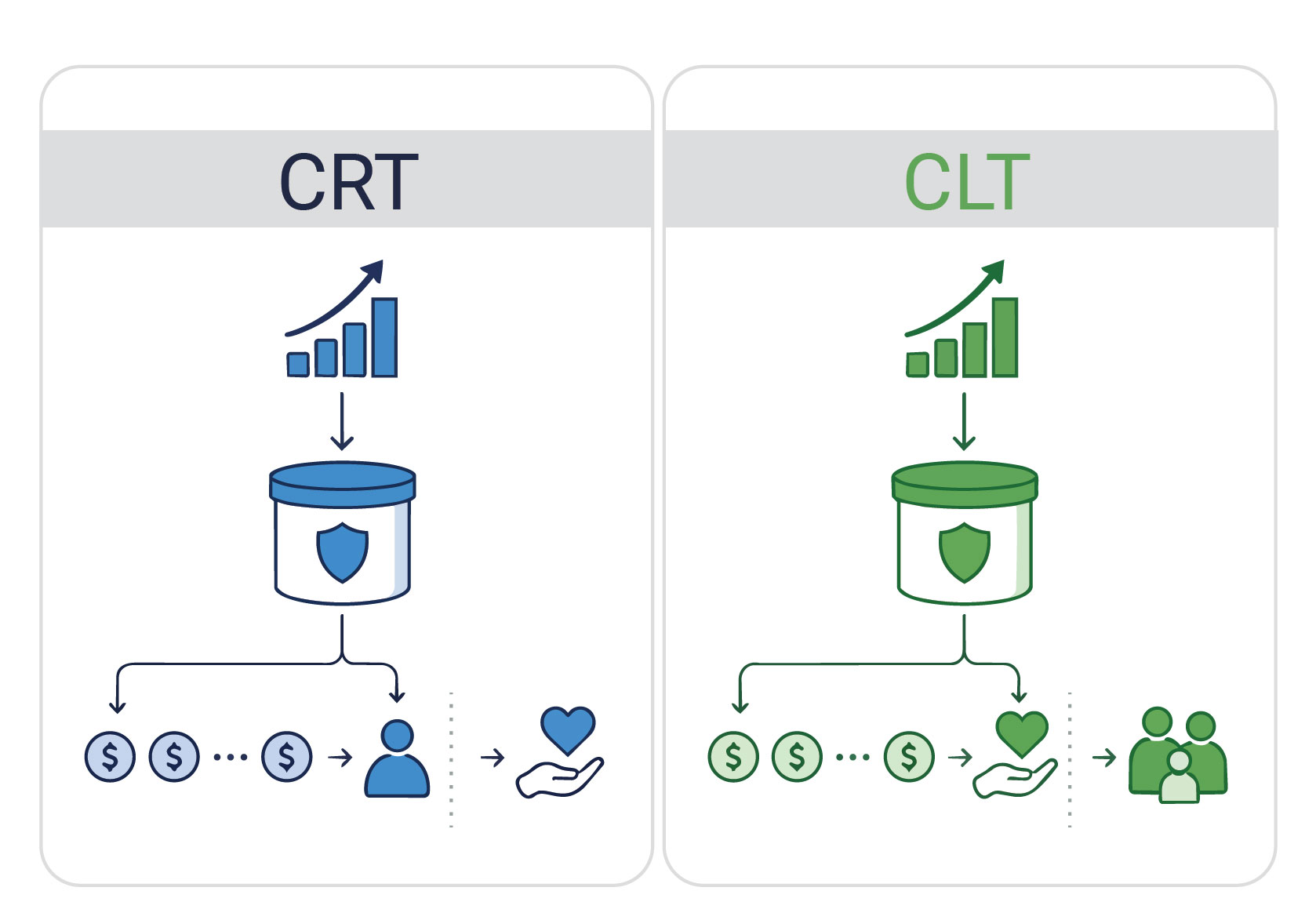
These are split-interest trusts. One party receives income for a period of years or a lifetime, and another party receives what remains. The split determines which trust applies.
A charitable remainder trust (CRT) pays income to you or a non-charitable beneficiary for a term of years or for life, then passes the remainder to charity. A charitable lead trust (CLT) does the reverse. Charity receives income during the trust term, and what remains passes to your heirs.
Advantages
- CRTs pair well with low-basis assets. The trust can sell the asset without immediate capital gains tax, then pay you or another beneficiary an income stream.
- CRTs provide a partial income tax deduction at funding, based on the present value of the charitable remainder.
- CLTs can transfer wealth to heirs at reduced gift or estate tax cost. Lower IRS Section 7520 rates make CLTs more efficient.
- Both can be structured for lifetime or term-of-years payouts, with fixed (annuity) or variable (unitrust) payments.
Disadvantages
- Once funded, the structure cannot be undone.
- Setup and ongoing cost. Legal drafting, trustee services, valuation, and tax filings add expense.
- Payout rates, IRS minimum and maximum percentages, and remainder values must be calculated to qualify.
- CLT income is generally not deductible to the grantor for income tax purposes in the most common (non-grantor) form.
Who It Fits
- Donors holding a low-basis, concentrated, or illiquid asset who want an income stream and a charitable outcome (CRT).
- Families looking to transfer significant wealth to the next generation while supporting charity, particularly in lower-rate environments (CLT).
- Clients who can commit capital irrevocably and want a defined giving structure over time.
Ready to talk to one of our experienced Financial Advisors? Book a consultation now.
What are Private Foundations?
A private foundation is a separate legal entity, typically an IRC 501(c)(3), funded and controlled by an individual, family, or company. The family directs grantmaking, investment policy, and governance.
Advantages
- The family selects board members, sets strategy, and approves every grant.
- Broad grantmaking. Grants to public charities, scholarship programs, individuals (with IRS approval), and international organizations are possible with proper structure.
- Family governance. A foundation gives the next generation a real role and a real seat at the table.
- The foundation can carry the family name across generations.
Disadvantages
- Higher cost and administration. Legal entity, board governance, annual Form 990-PF, and state filings all apply.
- Public disclosure. Form 990-PF includes grants, salaries, and investments, and is public record.
- Lower deduction limits. Cash gifts are deductible up to 30% of AGI, appreciated securities up to 20% of AGI.
- Excise tax. A 1.39% federal tax applies to net investment income.
- Strict rules. Self-dealing, the 5% minimum annual distribution, excess business holdings, and jeopardizing investment rules all apply.
Who It Fits
- Families committing meaningful capital, often $5 million or more, with multi-generational intent.
- Donors who want direct control over grantmaking and a formal role for family members.
- Clients building a long-term philanthropic identity beyond writing checks.
READ MORE: How a Well-Being Trust Expands Beyond Traditional Trust Planning
Comparison at a Glance
The table below summarizes the practical differences.
- Feature
- Setup Cost
- Ongoing Administration
- Deduction Limit, Cash
- Deduction Limit, Appreciated Assets
- Control Over Grants
- Investment Control
- Privacy
- Minimum Annual Payout
- Family Governance Role
- Typical Funding Range
- DAF
- Very low
- Minimal
- Up to 60%
- Up to 30% of AGI
- Recommend only
- Sponsor pools
- High
- None required
- Limited
- Any amount
- Charitable Trust
- Moderate to high
- Moderate
- Partial, based on remainder
- Partial, based on remainder
- Defined by trust terms
- Trustee directed
- Moderate
- Defined by trust
- Limited
- $500,000 and up
- Private Foundation
- High
- Significant
- Up to 30% of AGI
- Up to 20% of AGI
- Full
- Full
- Public Form 990-PF
- 5% of assets
- Strong
- $5 million and up
Choosing the Right Vehicle, or Combining Them
Many families use more than one structure. A DAF can handle annual giving while a private foundation carries long-term identity. A CRT can convert a low-basis position into income while a DAF receives later contributions. The right answer depends on your assets, income, family, and intent.
A useful first conversation usually answers four questions:
- What asset do you plan to give, and what is its cost basis?
- What is your income picture this year and over the next several years?
- What role do you want your family to play in giving?
- How much do control and privacy matter to you?
Your Verdence team works through these questions alongside your tax and legal advisors to align the vehicle with the rest of your plan.
Verdence: Your Partner in Financial Planning
Verdence works with clients to integrate charitable planning into a much larger wealth strategy. We coordinate with your tax and legal advisors on which assets to give, which sponsor fits your goals, and how to time the grants. Our role is to align your charitable plan with the rest of your financial life.
If a Charitable Remainder Trust is the right tool, we help you set it up, fund it, invest it, and manage grants over time. If a different vehicle like a DAF or Private Foundation fits better, we tell you. Verdence is a fiduciary. We are legally required to act in your interest.
What Sets Verdence Apart
- Unbiased Advice: As fiduciaries, we act in your best interest with complete transparency.
- Comprehensive Planning: From investing strategies to tax optimization, our approach seeks to integrate every aspect of your financial life.
- Family-Centered Service: We help you balance wealth preservation with the values and family legacy planning you want to pass down.
Take the Next Step Today
Contact Verdence to schedule a financial review and learn how we can help you focus on wealth while reducing stress. Together, we’ll create a clear, actionable plan for your financial future.
Author:
Carol Hopkins | Family Office Strategist
Frequently Asked Questions:
Can I use more than one charitable vehicle at the same time?
Yes. Many families pair a donor-advised fund for annual giving with a private foundation for long-term family identity or fund a charitable remainder trust with a concentrated stock position and direct the income to a donor-advised fund later. The vehicles work together rather than in competition.
Which vehicle gives me the biggest tax deduction?
Dollar for dollar, a donor-advised fund gives you the largest deduction: up to 60% of adjusted gross income for cash and 30% for appreciated securities. Private foundations cap those same limits at 30% and 20%. Charitable remainder trusts work differently altogether, since you only deduct the present value of what will eventually reach charity, not the full amount you contribute.
I own a low-basis, concentrated stock position. What should I do with it?
A charitable remainder trust is built for exactly this situation. It can sell the stock without triggering immediate capital gains tax, then pay you an income stream for a term of years or for life. A donor-advised fund avoids the same capital gains hit on contributed securities, but it doesn’t pay income back to you. If income isn’t a priority, going straight to a donor-advised fund is simpler and less expensive.
Do I have to give away money every year?
A private foundation has a hard rule: distribute 5% of its assets every year. A charitable trust follows whatever schedule its trust document sets instead. A donor-advised fund has no required payout at all under current rules, though that could change with future policy.
Can my foundation or donor-advised fund pay my child’s school tuition or fund a scholarship for my grandchild?
No. Neither vehicle can make grants to specific named individuals for personal benefit. A private foundation can run a scholarship program that follows IRS-approved, objective selection criteria open to a defined class of applicants, but it cannot direct funds to a specific person you choose.
How much does each vehicle cost to run?
Cost tracks complexity. A donor-advised fund is the cheapest option since there’s no legal entity to form, just a modest annual fee to the sponsor. Move to a charitable trust and you add legal drafting, a trustee, and ongoing tax filings. A private foundation sits at the top of the cost scale. Forming the entity, staffing a board, and filing the annual Form 990-PF add ongoing expense that a donor-advised fund doesn’t carry.
Is my giving private, or is it public record?
Privacy runs on a spectrum. A private foundation trades it away almost entirely. Its Form 990-PF, including grant recipients, staff salaries, and investment holdings, is available to the public. A donor-advised fund sits at the other end, since grants can be made anonymously. A charitable trust lands in the middle. Trust documents are generally private, but grant activity can surface in tax filings depending on how the trust is structured.
What’s the difference between a charitable remainder trust and a charitable lead trust?
A charitable remainder trust pays income to you or another named beneficiary first, then what remains goes to charity. A charitable lead trust reverses the order. The charity receives income during the trust term, and what remains passes to your heirs, often at a reduced gift or estate tax cost.
Can I take back control once I fund a charitable trust?
No. Charitable trusts are irrevocable. Once funded, you cannot undo the structure or reclaim the assets outside the terms you set at the start. A donor-advised fund is more flexible in the sense that you retain advisory privileges over grants, though legal control still sits with the sponsoring charity.
How much money do I need to start each vehicle?
The entry point rises with the structure. A donor-advised fund can be opened with almost any amount. Once you’re funding a charitable trust, $500,000 is the rough threshold where the setup and administrative cost start to make sense. Private foundations generally need $5 million or more to justify their ongoing complexity, though families with strong governance goals sometimes start smaller.
Who decides how the money is given, and can my family be involved?
Control and family involvement come down to which vehicle you choose. A private foundation offers the strongest role for both. Your family’s board has full authority over every grant decision, and members can serve on the board, shape grantmaking strategy, and vote together. A donor-advised fund works differently: you recommend grants and the sponsor almost always follows your lead, though it holds final legal authority, and family members can join as additional advisors on the account in a lighter, less formal role. A charitable trust offers the least ongoing flexibility on either front. Its charitable beneficiary is typically locked in at the trust’s outset, and it doesn’t include an ongoing family governance function.
Ready to talk to one of our experienced Financial Advisors? Book a consultation now.
Important Disclosure:
Verdence Capital Advisors LLC is providing this information as a guide. Verdence Capital Advisors LLC is not engaged in the practice of law and is not providing legal advice by the provision of this information. It is recommended that clients seek the opinion of their attorney regarding the specific legal and tax issues addressed herein.
