Author: Megan Horneman | Chief Investment Officer
Key Takeaways:
- Major financial firms scheduled to unofficially kick off 3Q25 earnings season tomorrow.
- Analysts increased S&P 500 earnings estimates during the quarter for only the fifth time since 2003.
- Technology and semiconductors will likely lead growth, but investors to scrutinize AI CapEx.
- Lower year-over-year crude oil prices continue to be a drag for the broader energy sector.
- Amid persistent inflation and ongoing tariffs, are companies passing on costs to consumers?
3Q25 Earnings Season Outlook – Bar Set High
This week marks the unofficial start to 3Q25 earnings season outlook. This is as major financial firms are scheduled to report results beginning on Tuesday (10/14). According to FactSet, analysts increased their S&P 500 year-over-year earnings estimates during the third quarter (from 7.3% to 8.0%).1 This would mark the ninth consecutive quarter of earnings growth for the Index. Interestingly, it is the first time analysts have increased EPS estimates during a quarter since 4Q21, and only the fifth time since 2003. In fact, over the past 20 years (80 quarters), analysts have decreased EPS estimates during a quarter by an average ~4%. This week, we showcase what investors can expect from 3Q25 earnings season outlook.
- Financials in the spotlight: Roughly 65% of the companies expected to report earnings this week come from Financials, (e.g., JPMorgan, Wells Fargo, Bank of America). The sector is expected to report the fourth-largest year-over-year earnings growth of all eleven sectors (+13%). All sub-industries are expected to be strong, with consumer finance (+29%) expected to lead. JPMorgan, Progressive, and Allstate have seen the largest upward revisions in their earnings since June 30. We will watch for clues into the strength of the IPO and M&A markets amid expectations for lower interest rates.
- CapEx spending in focus: The information technology sector is expected to report the largest year-over-year earnings growth rate of all eleven S&P sectors (+21%). The growth is being led by the semiconductor sub-industry (+45% YoY). If this sub-industry were excluded, the growth rate for the sector would be solid but more moderate (+~10%). We expect investors to scrutinize companies’ CapEx spending, specifically as it relates to AI. The “Magnificent 7” constituents account for ~30% of overall CapEx spending in the AI/data center buildout, so they will be worth monitoring. 2
- Energy expected to detract: The energy sector is expected to report the largest year-over-year earnings decline of all eleven S&P sectors (-4.2%). The average price of crude oil in 3Q25 was ~15% lower compared to a year ago.
The Bottom Line:
According to FactSet, over the past 10 years earnings growth has exceeded estimates by an average of ~5%. Applying this to the current estimate, 3Q25 earnings have the potential to rise double digits in 3Q25 (YoY). This would be the fourth-straight quarter of double-digit growth for the Index and the first double digit back-to-back growth since 3 & 4Q20. While we welcome a strong earnings season, we remain cautious about future earnings and are concerned that the recent upgrades may be overly optimistic.
The economy is slowing, inflation remains a key issue, and Government uncertainty remains high. We will monitor what companies are saying about tariffs and how much (if any) they are passing onto consumers. We are also watching what companies are saying about the labor market given the Federal Reserve has cited weakness as their reason to cut rates. Lastly, we will be monitoring if the surge in CapEx spending is still expected to have the profound effect on future earnings that high valuations are pricing in.
LISTEN NOW: Markets With Megan
Your Economic and Market Detailed Recaps
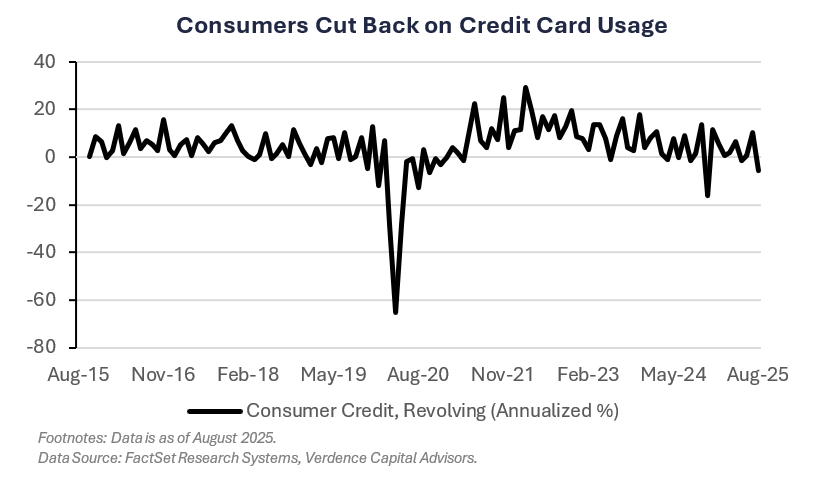
- Consumers borrow at slowest pace in six months.
- Fed minutes show split in rate path forward.
- Consumer sentiment unchanged in October.
- Global equities fall on breakdown in trade negotiations.
- U.S. yields fall as investors flock to safe-haven Treasuries.
- Commodities finish lower led by softs and grains.
Weekly Economic Recap — Fed Minutes Show Unanimity to Cut Rates, but Path Forward is Unclear
The New York Fed Survey of Consumer Expectations showed Americans are growing concerned about their financial situation amid increasing inflation pressures. One-year ahead inflation expectations increased to 3.4% (from 3.2%). This is while consumers’ expectations toward the probability of losing their job in the next 12 months increased.
Consumer borrowing increased at the slowest pace in six months ($363 million). This was amid a broad pullback in credit card balances. Revolving debt (including credit cards) decreased $6 billion after a surge in July, while non-revolving debt (i.e., car loans, school tuition, etc.) increased $6.3 billion.
The Federal Reserve released their September meeting minutes which showed near unanimity among participants to cut rates due to weakness in the labor market. “Participants expressed a range of views about the degree to which the current stance of monetary policy was restrictive and about the likely future path of policy”, the Minutes stated. A slim majority expects two more cuts by the end of the year (10) while the other group (9) expects three more cuts.
Consumer sentiment as tracked by the University of Michigan was relatively unchanged from September (55.0 vs. 55.1). Consumers viewed current finances and year-ahead business conditions as more favorable, but downgraded their expectations for future personal finances and buying conditions for durable goods. Inflation expectations for the year-ahead and the long-run were unchanged at 4.6% and 3.7%, respectively.
Weekly Market Recap — Global Equities Fall as U.S. Trade Negotiations Break Down with China
Equities:
The MSCI AC World Index was lower for the second time in three weeks as investors continued to asses the U.S. Government shutdown and renewed tariff uncertainty. All major U.S. averages fell with the bulk of the losses coming on Friday after Trump sparked concerns regarding China trade negotiations. The U.S. losses were led by small and midcap stocks. Developed international (i.e. MSCI EAFE) and the emerging markets fell but less than the losses in the U.S.
Fixed Income:
The Bloomberg Aggregate Index was higher for the second consecutive week as the U.S. Government shutdown continued and there were mixed comments from the Fed about future rate cuts. A flight to safety boosted Treasuries the most as higher yielding sectors (e.g. high yield and EM bonds) declined.
Commodities/FX:
The Bloomberg Commodity Index posted its worst week in the past 10 weeks. Softs led the broad index lower with particular weakness coming from coffee amid expectations for severe rain in Brazil. Grains were also lower as wheat prices fell on oversupply fears. Markets struggled for direction as key agriculture data was not release last week because of the shutdown.
WATCH NOW: Alternate View Podcast
Data is as of August 2025.
Data Source: FactSet Research Systems, Verdence Capital Advisors.
